SHJ in the classroom
Last year I was invited to give a guest lecture on PS:1014, which is a taster module on all-things psychology. The exciting bit was that I had the liberty to propose any topic related to my research, as long as it would be accessible to first year students. Computational psych? Too hard. Pavlovian conditioning? Too dry. Generative AI? Too trendy. So I decided to go with something that I have been working on for a while: categorisation.
I began with a crowd-pleaser, our study on pigeons categorising benign/malignant tumours (which was covered by the great Hannah Fry). That got the students thinking.
Then, we upped the speed a little, and I presented contemporary debates around the nature of human and non-human categorisation (basically, single- versus dual-system accounts).
Then we hit an early (but planned) break time. I told the students that I needed help with a little demonstration for later. I put a QR code pointing to a jsPsych experiment running on Pavlovia, and asked them to complete it on their phones. Only 16 trials.
Unbeknownst to them, they got one of three Shepard, Hovland, and Jenkins (SHJ) category structures, at random: Type I (unidimensional), Type II (XOR), and Type IV (family-resemblance).
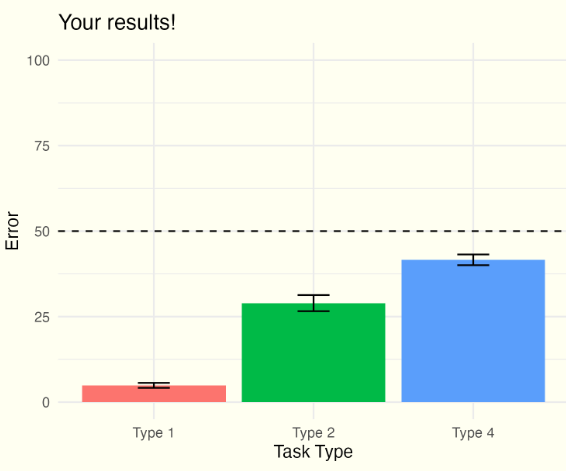
So, break’s over, and I jumped straight into explaining the SHJ experimental logic, as well as their critical finding: The Type II structure is a non-linear problem, with the highest structural complexity of the bunch, yet humans are able to learn it faster than the Type IV structure, which is a linear problem with lower structural complexity. This is known as the “Type II advantage”.
One slide later, I tell them: “Now, let’s see how you did.” And bang! One of the cleanest Type II advantage patterns I have ever seen. Well done Cardiff UGs!
Enjoy Reading This Article?
Here are some more articles you might like to read next: